
Blog / Research

2026 Ford Mustang GTD: 815 HP, Racing Technology & Performance

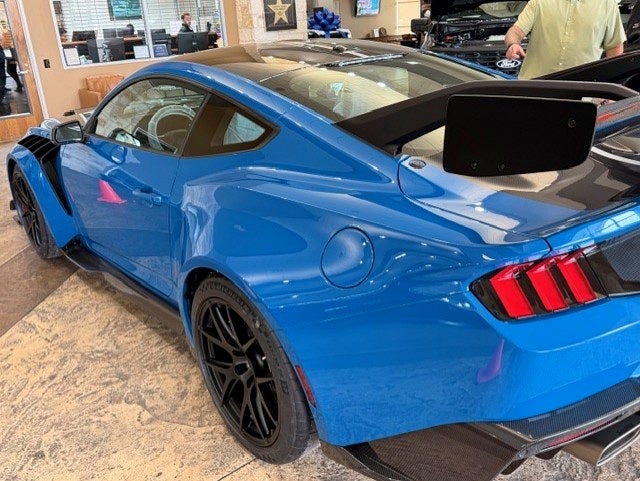
Rear three-quarter view of the GTD

When American muscle meets motorsport engineering, horsepower becomes only part of the equation.


There are fast cars, and then there are cars designed to challenge the definition of what a road car can accomplish. The 2026 Ford Mustang GTD belongs firmly in the latter category.

At first glance, its intentions are hardly subtle. An enormous rear wing, aggressive carbon-fiber aerodynamic components, widened bodywork and a purposeful front splitter leave little doubt about its priorities. This is not a Mustang designed merely to attract attention in a parking lot. It is a machine built around the relationship between power, aerodynamic efficiency and driver control.

Ford's ambition was straightforward: bring the thinking, technology and performance philosophy of international GT racing to a street-legal Mustang.

The result is a remarkable expression of American automotive engineering.

1. Power: The mathematics of American performance


At the heart of the Mustang GTD is a supercharged 5.2-liter V8 producing an extraordinary 815 horsepower and 664 lb-ft of torque.

Those numbers place the GTD in territory traditionally occupied by exotic European performance manufacturers. Yet the more interesting story is not the horsepower figure itself. It is how Ford engineered the vehicle to use that power.

The engine is paired with an eight-speed dual-clutch transmission connected to a rear-mounted transaxle. A carbon-fiber driveshaft transfers power from the front-mounted engine to the rear transmission, helping achieve a near 50/50 weight distribution.

This arrangement addresses one of the fundamental challenges of high-performance automobiles: delivering tremendous power without compromising balance.

With a reported top speed of 202 mph, the GTD is capable of extraordinary straight-line performance. But straight-line speed is only one measure of a performance car. The more demanding test comes when the road begins to turn.


2. Racing: Bringing the circuit to the street


The Mustang GTD's racing credentials are not simply a marketing exercise.

Its engineering draws heavily from Ford's Mustang GT3 racing programme, where aerodynamic efficiency, braking consistency, chassis balance and durability matter more than showroom appeal.

Consider the rear wing.

On an ordinary sports car, a spoiler might be primarily decorative. On the GTD, the rear aerodynamic package is part of a carefully engineered system intended to generate downforce and maintain stability at speed.

The front fender vents, aggressive splitter and underbody aerodynamic components serve similarly important purposes. They manage airflow around and beneath the vehicle, helping reduce unwanted aerodynamic lift while improving grip.

Ford's engineering ambition has been demonstrated at Germany's Nürburgring Nordschleife, one of the world's most demanding automotive testing grounds.

The Mustang GTD recorded a lap of 6 minutes and 40.835 seconds, becoming the first American production car to break the seven-minute barrier.

That achievement is more significant than a marketing statistic. It demonstrates what happens when an American manufacturer approaches performance engineering with the same intensity traditionally associated with European motorsport.

3. Control: Speed is meaningless without precision


Horsepower gets attention. Control earns respect.

The GTD's sophisticated suspension system, advanced aerodynamics and carbon-ceramic braking technology are designed to make its considerable performance usable.

Its semi-active suspension incorporates advanced damping and rear suspension geometry. The system can also lower the vehicle by approximately 40 millimetres for track driving.

This is particularly important because high-speed driving is not simply a question of acceleration. It involves maintaining tire contact, managing weight transfer and ensuring that the vehicle responds predictably when the driver demands more.

The braking system is equally serious. Brembo six-piston front brakes and carbon-ceramic rotors provide the stopping capability required of a vehicle capable of exceeding 200 mph.

The available active aerodynamic system adds another dimension, adjusting aerodynamic components to balance downforce and drag.

In other words, Ford has not simply built an engine capable of producing extraordinary numbers. It has engineered an entire vehicle around controlling those numbers.

4. An American answer to the supercar establishment


For decades, the highest levels of automotive performance have been associated with European names. Ferrari, Porsche, Lamborghini and McLaren have established formidable reputations through engineering, racing and technological innovation.

The Mustang GTD represents a distinctly American challenge to that establishment.

It retains the unmistakable character of the Mustang while embracing engineering solutions that extend well beyond traditional muscle-car conventions.

Its supercharged V8 delivers the drama enthusiasts expect. Its aerodynamic package and chassis technology address the demands of modern circuit driving. And its Nürburgring performance provides measurable evidence that Ford's ambitions extend well beyond straight-line acceleration.

The GTD does not ask whether an American manufacturer can build a supercar. It makes a rather more interesting argument: why should America settle for anything less?

The Verdict: Power creates the opportunity. Engineering creates the performance.


The 2026 Ford Mustang GTD illustrates an important distinction in modern automotive design.

Power is relatively easy to advertise. Making that power effective, repeatable and controllable is considerably more difficult.

Ford has approached the GTD as an integrated performance system. Its engine, transmission, suspension, braking and aerodynamic components are designed to work together rather than compete for attention.

For enthusiasts, the GTD represents an extraordinary chapter in Mustang history. For the automotive industry, it is evidence that American performance engineering can compete on an international stage.

And for anyone who believes a Mustang should be about more than simply making noise and going fast, the GTD offers a compelling answer.

This is what happens when horsepower meets discipline.

Posted in:

Related Posts

2027 Ford Explorer with middle and back seats folded down

2027 Ford Explorer Third-Row Seating: How Much Space Does the Explorer Really Have?

When shoppers start looking for a three-row SUV, the number of seats is only the beginning of the conversation. The real questions are more practical: How comfortable is the third row? Can adults sit back there? How much cargo space remains with all three rows in use? Can the second row be configured for six or seven passengers? And which 2027 Ford Explorer trim offers the best combination of passenger and cargo flexibility? The 2027 Ford Explorer is designed around those questions. Every Explorer model has three rows of seating, and Ford lists a maximum seating capacity of either six or seven occupants depending on the configuration. Second-row captain's chairs are standard, while a second-row bench seat is available on every 2027 Explorer except the Tremor, allowing certain configurations to accommodate seven passengers. That makes the 2027 Explorer more than simply an SUV with an extra row. It is a three-row vehicle designed to give families multiple ways to balance passengers, cargo and everyday usability. 2027 Ford Explorer Seating Capacity: Six or Seven Passengers One of the first things to understand about 2027 Ford Explorer seating is that not every Explorer seats seven people. The standard configuration uses second-row captain's chairs, creating a six-passenger layout. This configuration provides a natural walkway between the second-row seats and gives passengers easier access to the third row. For shoppers who need maximum passenger capacity, an available second-row bench seat creates a seven-passenger configuration on eligible models. Ford states that the second-row bench is available on all 2027 Explorer models except the Tremor. That distinction is important for families. Someone shopping for a three-row SUV should not simply search for "seven-passenger Explorer." They should also determine which second-row configuration they want. 2027 Ford Explorer Seating Configurations Configuration Seating Capacity Second Row Third Row Captain's chairs 6 Two individual seats Standard Second-row bench 7 Three-person bench Standard Tremor 6 Captain's chairs Standard The Tremor is the exception because its second-row captain's chairs are standard, giving it a six-passenger configuration. For many families, six-passenger seating may actually be desirable. Captain's chairs can make it easier for children to access the third row without requiring passengers to climb across a second-row bench. How Much Third-Row Legroom Does the 2027 Ford Explorer Have? This is one of the most important specifications for anyone researching 2027 Ford Explorer third-row seating. Ford lists third-row legroom at 31.8 inches across the 2027 Explorer lineup. Third-row headroom is listed at 38.9 inches. Those measurements put the third row into proper perspective. The Explorer provides: 43.0 inches of front-row legroom on Active and ST-Line 37.5 inches of second-row legroom on Active and ST-Line 31.8 inches of third-row legroom 40.7 inches of front-row headroom 40.5 inches of second-row headroom 38.9 inches of third-row headroom Tremor, Platinum and ST have slightly different second-row measurements, but the third-row legroom and headroom remain listed at 31.8 and 38.9 inches respectively. What Does 31.8 Inches of Third-Row Legroom Mean? Specifications are useful, but shoppers ultimately want to know what they mean in real life. The third row is particularly useful for: Children Teenagers Shorter adults Carpool passengers Occasional adult passengers Families who need additional seating without moving to a larger full-size SUV For a family that frequently carries children in multiple rows, the Explorer's three-row layout can be especially useful. Instead of treating the third row as emergency seating only, families can use it as part of their normal passenger configuration. And when the third row isn't needed, the Explorer's interior can quickly shift from passenger transportation to cargo hauling. 2027 Ford Explorer Cargo Space Behind the Third Row One of the biggest concerns with any three-row SUV is what happens to cargo space when all the seats are occupied. The 2027 Explorer provides 16.3 cubic feet of cargo capacity behind the third row with all seats in place. That matters because three-row SUVs can become surprisingly limited when every seat is occupied. With the Explorer, the space behind the third row can accommodate the everyday items families commonly carry, while folding the rear seating opens substantially more room. Ford lists maximum cargo capacity at: 85.8 cubic feet for Explorer Active 85.8 cubic feet for Explorer ST-Line 85.3 cubic feet for Explorer Tremor 85.3 cubic feet for Explorer Platinum 85.3 cubic feet for Explorer ST That gives the Explorer a useful transformation: it can function as a people mover during the week and a much larger cargo hauler when the rear rows are folded. Which 2027 Ford Explorer Has the Best Third-Row Seating? Because the basic third-row dimensions are shared across the lineup, choosing an Explorer based strictly on third-row measurements doesn't tell the whole story. The differences become more significant when you consider seat configuration, folding functionality and the overall mission of each trim. 2027 Ford Explorer Active The Active provides the foundation of the Explorer lineup while retaining the three-row configuration. It seats six with the standard second-row captain's chairs and can accommodate seven with the available second-row bench. Ford lists 31.8 inches of third-row legroom and 38.9 inches of third-row headroom. For families primarily interested in practical three-row transportation, the Active is an important starting point. 2027 Ford Explorer ST-Line The ST-Line combines the Explorer's three-row practicality with a more performance-inspired appearance. Like the Active, it can seat six or seven depending on the second-row configuration. It also provides 16.3 cubic feet behind the third row and up to 85.8 cubic feet of maximum cargo capacity. That makes the ST-Line particularly interesting for shoppers who want a family-oriented three-row SUV without giving up a sportier visual character. 2027 Ford Explorer Tremor The Tremor takes the Explorer in a different direction. It seats six because second-row captain's chairs are standard, while its third row remains standard equipment. Ford lists available PowerFold third-row seating for the Tremor. The Tremor therefore represents an interesting combination: an Explorer designed with additional off-road capability while retaining three-row practicality. 2027 Ford Explorer Platinum The Platinum takes the Explorer toward the luxury end of the lineup. Second-row captain's chairs are standard, with the available bench creating a seven-passenger configuration. Importantly for shoppers who frequently change between passenger and cargo configurations, PowerFold third-row seats are standard on Platinum. 2027 Ford Explorer ST The Explorer ST adds performance to the three-row SUV formula. It comes standard with the 3.0-liter EcoBoost V6 and retains the Explorer's three-row layout. PowerFold third-row seats are standard on the ST, while an available second-row bench can create a seven-passenger configuration. This makes the ST an interesting choice for someone who doesn't want to give up performance simply because they need three rows of seating. Is the 2027 Ford Explorer a Good Family SUV? For many families, the appeal of the Explorer's third row isn't simply the ability to carry more people. It's the ability to change configurations as family needs change. A typical weekday might involve children sitting in the second row while another passenger occupies the third row. On another day, the third row might be folded to make room for groceries, sports equipment or luggage. The Explorer's three-row design provides that flexibility without requiring the owner to drive a full-size SUV. Its 119.1-inch wheelbase and 198.7-inch overall length give the Explorer substantial interior volume while maintaining a footprint that remains firmly in the midsize SUV category. That combination is one of the reasons three-row SUVs have become such an important category for families. Can Adults Sit in the Third Row of the 2027 Ford Explorer? The answer depends heavily on the individual passenger. The 2027 Explorer's third row provides 31.8 inches of legroom and 38.9 inches of headroom. For children and teenagers, that space can be particularly useful. Smaller adults can also use the third row, particularly for shorter trips. For larger adults on long journeys, however, the third row should be evaluated personally. Body size, seating position and the amount of second-row adjustment available can all affect perceived comfort. That's an important point for dealership SEO content: don't simply tell shoppers that a vehicle has a third row. Help them understand who that third row is designed to accommodate. That type of useful information is far more valuable than repeating "three-row SUV" throughout an article. 2027 Ford Explorer Third Row vs. Second Row The Explorer demonstrates why three-row SUVs require a compromise between passenger capacity and space. The front row provides the greatest amount of legroom, followed by the second row and then the third row. For Active and ST-Line models, Ford lists: Front row: 43.0 inches of legroom Second row: 37.5 inches Third row: 31.8 inches This makes the second row an especially important part of the Explorer's overall passenger experience. With captain's chairs, second-row passengers have individual seats and a passageway toward the third row. With the available bench, the Explorer gains another seating position. The choice ultimately comes down to whether the buyer prioritizes maximum passenger capacity or easier movement between rows. 2027 Ford Explorer Third-Row Seating and Cargo: The Real Advantage Perhaps the most compelling feature of the Explorer's three-row design is not the third row itself. It is what happens when you don't need it. With all seats in place, the Explorer has 16.3 cubic feet of cargo capacity behind the third row. Fold the rear seating, and maximum cargo capacity increases to as much as 85.8 cubic feet on Active and ST-Line models. That makes the Explorer adaptable to completely different situations. Family road trip: Three rows of passengers plus luggage. School carpool: Multiple passengers without sacrificing the entire cargo area. Grocery run: Third row available when needed, cargo area available when it isn't. Home improvement trip: Fold the rear seats and use the Explorer as a cargo hauler. Weekend adventure: Carry people, equipment and supplies in the same vehicle. This is where the Explorer's third-row design becomes more than a specification. It becomes a tool for changing how the vehicle is used. 2027 Ford Explorer Third-Row Seating: Frequently Asked Questions Does every 2027 Ford Explorer have a third row? Yes. Ford states that all 2027 Explorer models have third-row seats. How many people can the 2027 Ford Explorer seat? The 2027 Explorer can seat six or seven people depending on the model and configuration. Captain's chairs provide six-passenger seating, while an available second-row bench provides seven-passenger seating on eligible models. Does the 2027 Ford Explorer have seven seats? Yes, certain configurations have seven seats. The available second-row bench provides the additional seating position. The Tremor is limited to six seats because captain's chairs are standard. How much legroom does the 2027 Ford Explorer third row have? Ford lists 31.8 inches of third-row legroom across the 2027 Explorer lineup. How much headroom does the third row have? The 2027 Explorer provides 38.9 inches of third-row headroom. How much cargo space is behind the third row? The 2027 Explorer has 16.3 cubic feet of cargo capacity behind the third row with all seats in place. Which Explorer has PowerFold third-row seats? PowerFold third-row seats are standard on the 2027 Explorer ST and Platinum. They are available on the Tremor. Is the 2027 Explorer good for families? Its combination of three rows, six- or seven-passenger configurations, flexible cargo space and available seating configurations makes the Explorer particularly relevant to shoppers looking for a midsize three-row SUV. The best configuration depends on passenger needs, cargo requirements and preferred equipment. The Bottom Line on 2027 Ford Explorer Third-Row Seating The 2027 Ford Explorer third row is an important part of what makes the SUV so versatile. Every Explorer has three rows, shoppers can choose between six- and seven-passenger configurations on eligible trims, and Ford provides 31.8 inches of third-row legroom and 38.9 inches of third-row headroom. More importantly, the Explorer doesn't force owners to choose permanently between passenger space and cargo space. With 16.3 cubic feet behind the third row and as much as 85.8 cubic feet of maximum cargo capacity on Active and ST-Line models, the interior can adapt as the demands of the day change.

2027 Explorer Active next to Explorer ST-Line

2027 Ford Explorer Active vs. ST-Line: Which Ford Explorer Is Right for You?

If you're searching for a new 2027 Ford Explorer, two of the most compelling trims to compare are the 2027 Ford Explorer Active and 2027 Ford Explorer ST-Line. Both deliver the spacious three-row interior, turbocharged EcoBoost® performance, advanced technology and SUV versatility that make the Explorer a standout choice for families, commuters and adventure seekers. But when you look closer at the Ford Explorer Active vs. ST-Line, you'll find two distinct approaches to the Explorer. The Active is built around the idea of a versatile, well-equipped SUV that can handle everyday driving, family trips and weekend adventures. The ST-Line takes that same Explorer foundation and adds a more aggressive, performance-inspired appearance along with additional premium technology and interior features. If you're trying to decide which 2027 Ford Explorer trim belongs in your driveway, here's what separates these two popular models. 2027 Ford Explorer Active: Versatility Comes Standard The 2027 Ford Explorer Active is designed to deliver the essential capabilities that Explorer shoppers want without compromising on modern technology. Under the hood is a 2.3-liter EcoBoost® four-cylinder engine producing 300 horsepower, paired with a 10-speed automatic transmission. Rear-wheel drive is standard, while available Intelligent 4WD gives drivers additional traction for changing road and weather conditions. The Active also comes prepared for serious utility. When properly equipped, the 2027 Explorer Active can tow up to 5,000 pounds, and Ford includes a Class III Trailer Tow Package as standard equipment. That makes the Active more than a family hauler—it can also be equipped to pull a trailer, boat, recreational equipment or other weekend gear. Inside, the Active provides the technology today's SUV shoppers expect, including a 13.2-inch center touchscreen, a 12.3-inch digital instrument cluster, wireless Apple CarPlay® and Android Auto™, Ford Digital Experience and FordPass® Connect. Ford Co-Pilot360® Assist+ is also standard, adding a comprehensive collection of driver-assistance technologies. For shoppers searching for a 2027 Ford Explorer Active for sale, the Active deserves serious consideration because it combines three-row practicality, strong turbocharged performance, towing capability and modern technology into one highly versatile SUV. 2027 Ford Explorer ST-Line: Sportier Style and Premium Technology The 2027 Ford Explorer ST-Line takes the Explorer in a more aggressive direction. It retains the same 2.3-liter EcoBoost engine and 300 horsepower as the Active, so choosing the ST-Line isn't primarily about gaining additional engine output. Instead, Ford gives the ST-Line a distinctive appearance and an upgraded collection of features designed for shoppers who want their Explorer to make a stronger visual statement. The ST-Line's performance-inspired styling is one of its biggest advantages. Unique ST-Line badging, darker exterior accents and larger wheels give the SUV a more athletic appearance than the Active. For buyers who want the look of a performance-oriented SUV without stepping all the way up to the high-performance Explorer ST, the ST-Line occupies an interesting position in the lineup. Inside, the ST-Line adds even more reasons to consider upgrading. Available and standard equipment can include features such as a 360-degree camera, heated front seats, a heated leather-wrapped steering wheel, red stitching accents and a B&O® Sound System by Bang & Olufsen® with 10 speakers. The ST-Line also offers access to BlueCruise® hands-free highway driving technology when properly equipped. For shoppers searching for a 2027 Ford Explorer ST-Line for sale, these upgrades can make the ST-Line particularly appealing to drivers who want a more distinctive exterior and a more premium driving environment. Ford Explorer Active vs. ST-Line: What's the Difference? The biggest difference between the 2027 Explorer Active and ST-Line isn't horsepower. Both trims use the 2.3-liter EcoBoost engine with 300 horsepower. Instead, the distinction comes down to equipment, design and the overall character of each SUV. The Active emphasizes versatility and everyday functionality. Its standard 18-inch wheels, practical exterior design, three-row seating and available 4WD make it a natural choice for families and drivers who want an SUV capable of handling everything from the daily commute to weekend travel. The ST-Line emphasizes sport-inspired design and additional technology. Its distinctive exterior styling, larger wheels, premium interior touches, upgraded audio system and available BlueCruise technology give it a more upscale and athletic personality. 2027 Ford Explorer Active vs. ST-Line Comparison Feature 2027 Explorer Active 2027 Explorer ST-Line Engine 2.3L EcoBoost I-4 2.3L EcoBoost I-4 Horsepower 300 hp 300 hp Transmission 10-speed automatic 10-speed automatic Rear-Wheel Drive Available Available Intelligent 4WD Available Available Maximum Towing Up to 5,000 lbs. Up to 5,000 lbs. when properly equipped Seating Up to 7 Up to 7 Center Display 13.2 inches 13.2 inches Digital Instrument Cluster 12.3 inches 12.3 inches Apple CarPlay / Android Auto Standard Standard Exterior Character Versatile Performance-inspired 360-Degree Camera Available Available/depending on configuration B&O Audio Available depending on configuration Available/depending on configuration BlueCruise Available Available ST-Line Styling — Standard Equipment and availability can vary by configuration. Consult Ford for the latest specifications and package details. Which 2027 Ford Explorer Should You Choose? Choosing between the 2027 Ford Explorer Active and ST-Line ultimately comes down to the type of Explorer you want to drive every day. If your priorities are versatility, capability, three-row space and everyday practicality, the Explorer Active gives you an impressive foundation. With 300 horsepower, available Intelligent 4WD, up to 5,000 pounds of towing capacity and a long list of standard technology, the Active is engineered to handle considerably more than the average family crossover. If you want your new Explorer to have more aggressive styling, additional premium features and a sportier personality, the ST-Line deserves a close look. Its performance-inspired appearance separates it from the rest of the Explorer lineup, while its available technology and upgraded interior features create a more premium experience. Find Your New 2027 Ford Explorer Whether you're interested in an Explorer Active or Explorer ST-Line, the best way to choose is to experience both. Sit behind the wheel, compare the interior features, explore the available technology and see which exterior design fits your style. When you're ready to find a new 2027 Ford Explorer for sale, explore available Explorer inventory and compare Active and ST-Line models equipped with the features that matter most to you. Whether you're looking for a versatile family SUV, a capable road-trip vehicle or a three-row SUV with a sportier appearance, there's a 2027 Ford Explorer configuration designed to fit the way you drive. Ready to find your next Explorer? Browse our new Ford Explorer inventory, compare available trims and contact your local sales expert today.

2027 Ford Explorer vs. 2027 Volkswagen Atlas | Why Buy the Explorer?

If you're shopping for a three-row SUV in Central Texas, the 2027 Ford Explorer and 2027 Volkswagen Atlas deserve a spot on your comparison list. The redesigned Atlas offers impressive passenger space and a new 282-horsepower turbocharged engine, making it a legitimate competitor. But for drivers looking for a combination of performance, capability, technology, and versatility, the Ford Explorer brings considerably more to the table. More Power and Performance The 2027 Ford Explorer starts with a 300-horsepower 2.3-liter EcoBoost engine, while the available 3.0-liter EcoBoost V6 produces up to 400 horsepower. The Explorer also offers available Intelligent 4WD, giving drivers additional flexibility for changing road and terrain conditions. The Atlas uses a turbocharged four-cylinder producing 282 horsepower. For shoppers who want a three-row SUV that delivers more than basic family transportation, the Explorer's available V6 performance is a major advantage. Built for Texas Families and Adventures The Explorer can tow up to 5,000 pounds and offers up to 85.8 cubic feet of cargo capacity, giving Central Texas drivers plenty of capability for trailers, recreational equipment, luggage, and family gear. The Explorer lineup also gives shoppers more ways to match an SUV to their lifestyle, including the premium Platinum, performance-oriented ST, and adventure-ready Tremor. The Atlas offers impressive interior space, but the Explorer brings something particularly valuable to shoppers: choice. Whether you're looking for an everyday family SUV, a luxury-oriented three-row vehicle, a high-performance SUV, or something ready for weekend adventures, there's an Explorer designed around your priorities. Why Buy the 2027 Ford Explorer? For shoppers comparing the 2027 Ford Explorer vs. Volkswagen Atlas, the decision ultimately comes down to what you expect from your SUV. The Atlas is spacious and competitive, but the Explorer combines 300-horsepower standard performance, up to 400 horsepower, 5,000-pound towing, available 4WD, available Ford BlueCruise hands-free highway driving, and multiple specialized trims. If you're looking for a three-row SUV near Marble Falls, Austin, Burnet, Horseshoe Bay, Llano, or throughout the Texas Hill Country, put the 2027 Ford Explorer at the top of your test-drive list. The Volkswagen Atlas may give you another option—but the Ford Explorer gives you more ways to make your SUV fit the way you live and drive.