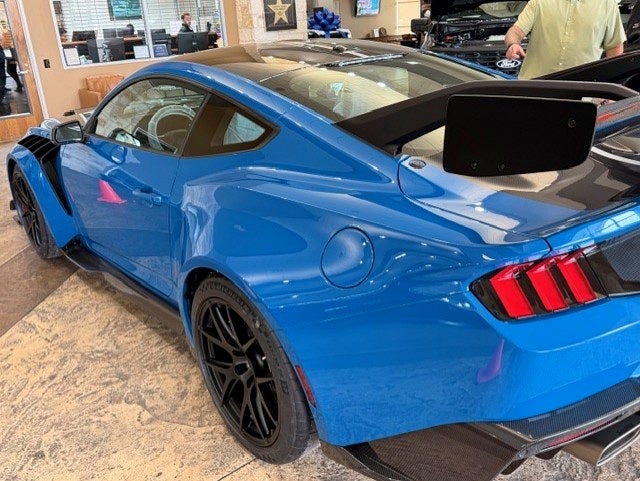

When American muscle meets motorsport engineering, horsepower becomes only part of the equation. There are fast cars, and then there are cars designed to challenge the definition of what a road car can accomplish. The 2026 Ford Mustang GTD belongs firmly in the latter category. At first glance, its intentions are hardly subtle. An enormous rear wing, aggressive carbon-fiber aerodynamic components, widened bodywork and a purposeful front splitter leave little doubt about its priorities. This is not a Mustang designed merely to attract attention in a parking lot. It is a machine built around the relationship between power, aerodynamic efficiency and driver control. Ford's ambition was straightforward: bring the thinking, technology and performance philosophy of international GT racing to a street-legal Mustang. The result is a remarkable expression of American automotive engineering. 1. Power: The mathematics of American performance At the heart of the Mustang GTD is a supercharged 5.2-liter V8 producing an extraordinary 815 horsepower and 664 lb-ft of torque. Those numbers place the GTD in territory traditionally occupied by exotic European performance manufacturers. Yet the more interesting story is not the horsepower figure itself. It is how Ford engineered the vehicle to use that power. The engine is paired with an eight-speed dual-clutch transmission connected to a rear-mounted transaxle. A carbon-fiber driveshaft transfers power from the front-mounted engine to the rear transmission, helping achieve a near 50/50 weight distribution. This arrangement addresses one of the fundamental challenges of high-performance automobiles: delivering tremendous power without compromising balance. With a reported top speed of 202 mph, the GTD is capable of extraordinary straight-line performance. But straight-line speed is only one measure of a performance car. The more demanding test comes when the road begins to turn. 2. Racing: Bringing the circuit to the street The Mustang GTD's racing credentials are not simply a marketing exercise. Its engineering draws heavily from Ford's Mustang GT3 racing programme, where aerodynamic efficiency, braking consistency, chassis balance and durability matter more than showroom appeal. Consider the rear wing. On an ordinary sports car, a spoiler might be primarily decorative. On the GTD, the rear aerodynamic package is part of a carefully engineered system intended to generate downforce and maintain stability at speed. The front fender vents, aggressive splitter and underbody aerodynamic components serve similarly important purposes. They manage airflow around and beneath the vehicle, helping reduce unwanted aerodynamic lift while improving grip. Ford's engineering ambition has been demonstrated at Germany's Nürburgring Nordschleife, one of the world's most demanding automotive testing grounds. The Mustang GTD recorded a lap of 6 minutes and 40.835 seconds, becoming the first American production car to break the seven-minute barrier. That achievement is more significant than a marketing statistic. It demonstrates what happens when an American manufacturer approaches performance engineering with the same intensity traditionally associated with European motorsport. 3. Control: Speed is meaningless without precision Horsepower gets attention. Control earns respect. The GTD's sophisticated suspension system, advanced aerodynamics and carbon-ceramic braking technology are designed to make its considerable performance usable. Its semi-active suspension incorporates advanced damping and rear suspension geometry. The system can also lower the vehicle by approximately 40 millimetres for track driving. This is particularly important because high-speed driving is not simply a question of acceleration. It involves maintaining tire contact, managing weight transfer and ensuring that the vehicle responds predictably when the driver demands more. The braking system is equally serious. Brembo six-piston front brakes and carbon-ceramic rotors provide the stopping capability required of a vehicle capable of exceeding 200 mph. The available active aerodynamic system adds another dimension, adjusting aerodynamic components to balance downforce and drag. In other words, Ford has not simply built an engine capable of producing extraordinary numbers. It has engineered an entire vehicle around controlling those numbers. 4. An American answer to the supercar establishment For decades, the highest levels of automotive performance have been associated with European names. Ferrari, Porsche, Lamborghini and McLaren have established formidable reputations through engineering, racing and technological innovation. The Mustang GTD represents a distinctly American challenge to that establishment. It retains the unmistakable character of the Mustang while embracing engineering solutions that extend well beyond traditional muscle-car conventions. Its supercharged V8 delivers the drama enthusiasts expect. Its aerodynamic package and chassis technology address the demands of modern circuit driving. And its Nürburgring performance provides measurable evidence that Ford's ambitions extend well beyond straight-line acceleration. The GTD does not ask whether an American manufacturer can build a supercar. It makes a rather more interesting argument: why should America settle for anything less? The Verdict: Power creates the opportunity. Engineering creates the performance. The 2026 Ford Mustang GTD illustrates an important distinction in modern automotive design. Power is relatively easy to advertise. Making that power effective, repeatable and controllable is considerably more difficult. Ford has approached the GTD as an integrated performance system. Its engine, transmission, suspension, braking and aerodynamic components are designed to work together rather than compete for attention. For enthusiasts, the GTD represents an extraordinary chapter in Mustang history. For the automotive industry, it is evidence that American performance engineering can compete on an international stage. And for anyone who believes a Mustang should be about more than simply making noise and going fast, the GTD offers a compelling answer. This is what happens when horsepower meets discipline.